

Accademia Artists | Location Schedule Tickets Authorizations
Artists Tintoretto | Veronese |
Tintoretto Crucifixion | Cain Abel | Miracle St Mark | Jesus Temple | Translation St Mark | Lady Treasurers | St George Princess | St Mark Saracen | Adam Eve | Assumption Virgin | Deposition Christ | Creation Animals | Mocenigo | Soranzo | St Jerome Andrew
Tintoretto’s “The Translation of the Body of St. Mark” at the Accademia Galleries in Venice
Tintoretto (1518 – 31 May 1594) “The Translation of the Body of St. Mark”
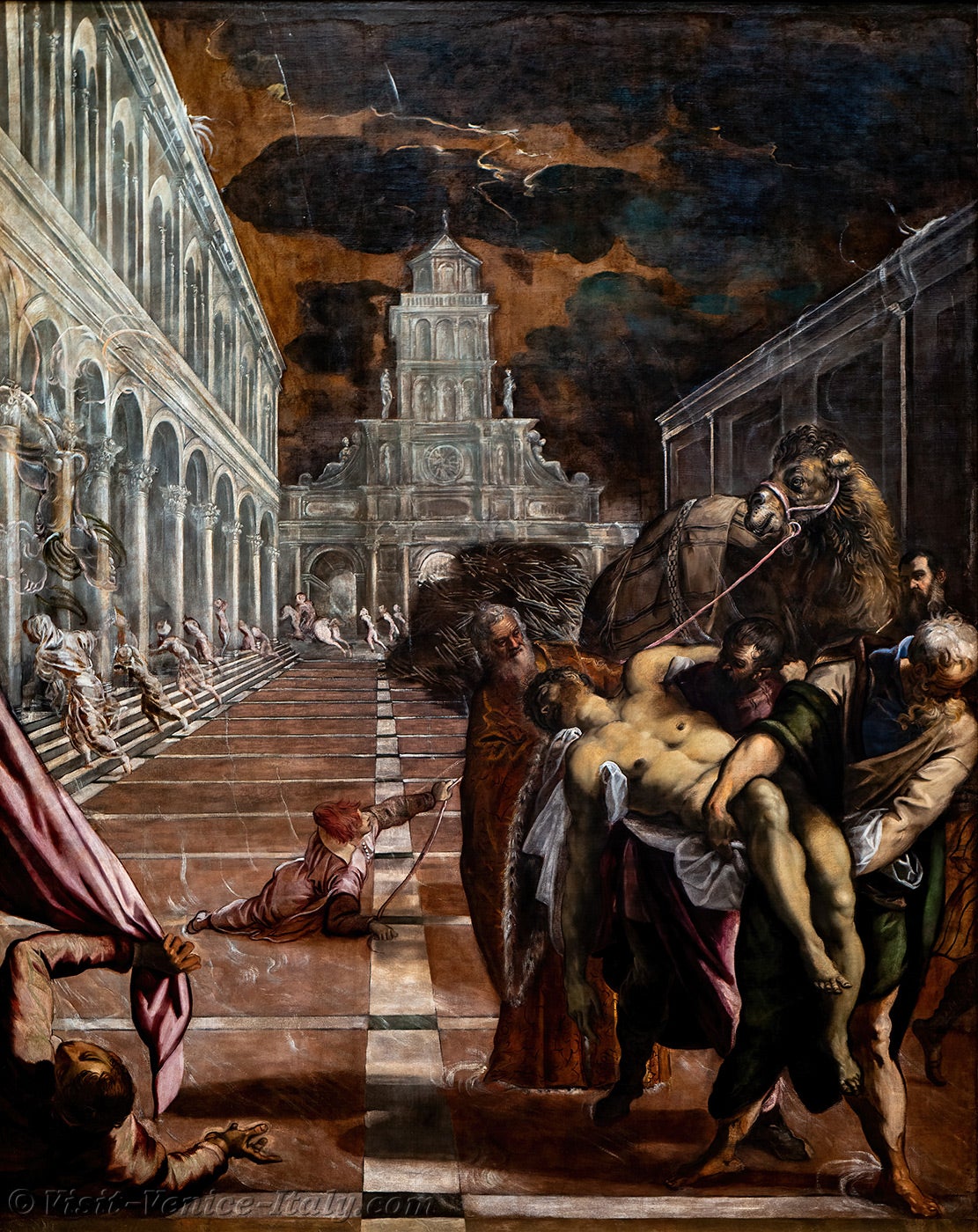
Translation of St Mark Painting – Oil on canvas (397 x 315 cm) 1562–1566
This painting had a history identical to that of “Saint Mark Rescuing a Saracen from a Shipwreck”, as it was exhibited at the Scuola Grande St. Mark until 1807, then at the Doge's Palace until 1815, and subsequently at the Marciana Library until 1866.
At that time, the Austrians, who were occupying Venice, decided to seize this masterpiece to exhibit it at the Hof Museum in Vienna from 1866 to 1868.
The work then returned to its place in the Marciana Library until 1919, before finally being exhibited at the Accademia Gallery from 1920.
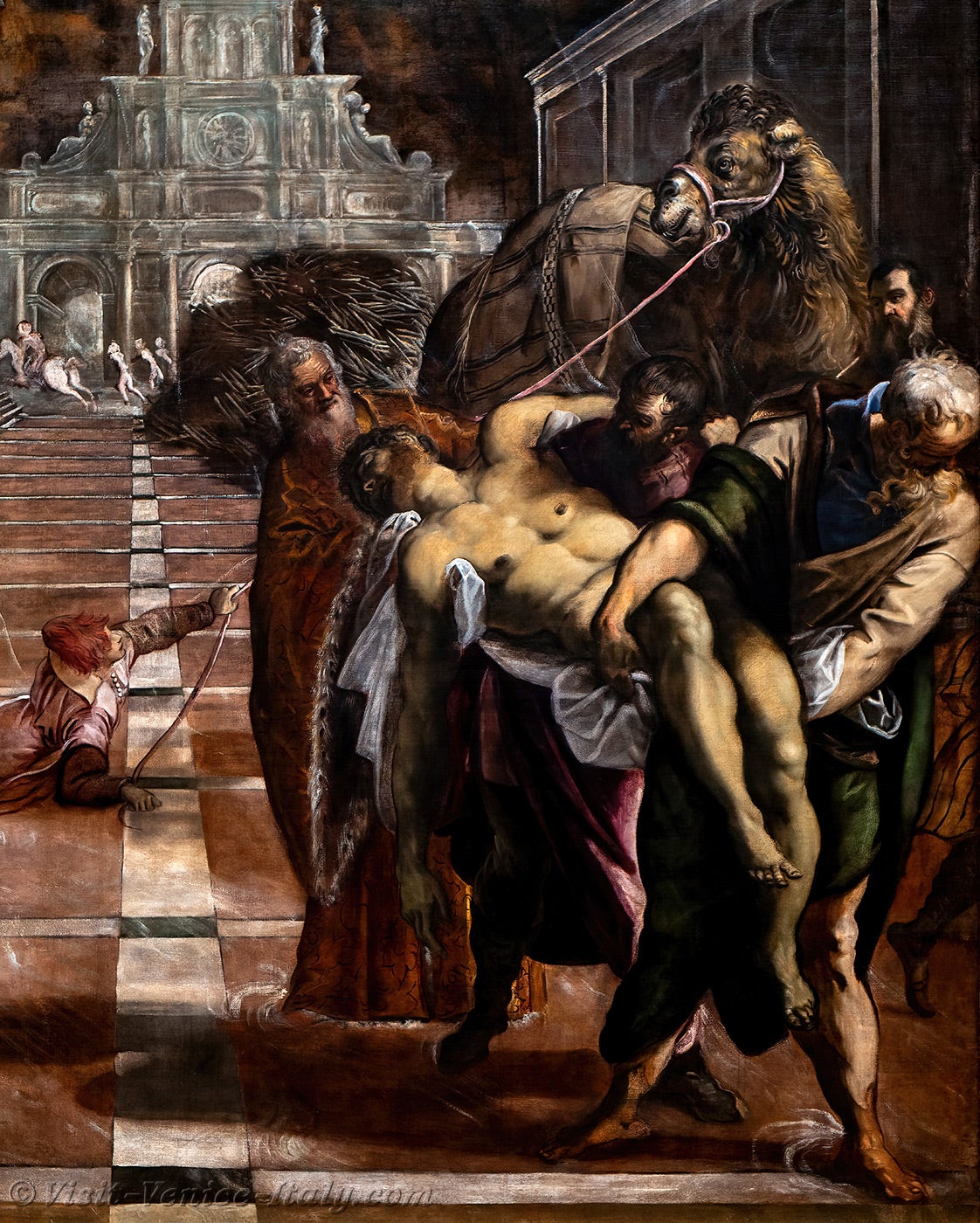
Translation of St Mark In this painting, a violent storm accompanied by hail drives the pagans to flight just as they were about to burn the saint’s body, a miracle which enabled the Christians to remove the body of St. Mark from the pyre and hide it until, eight centuries later, the Venetians secretly transported it from the city of Alexandria in Egypt to Venice.
As mentioned above, this painting and those depicting the rescue of a Saracen by St. Mark as well as “the discovery of St. Mark’s body”, now on display in Milan at the Pinacoteca di Brera, formed part of a narrative cycle relating to the life of St. Mark.
This cycle had been painted by Tintoretto to decorate the chapter house of the Scuola Grande di San Marco.
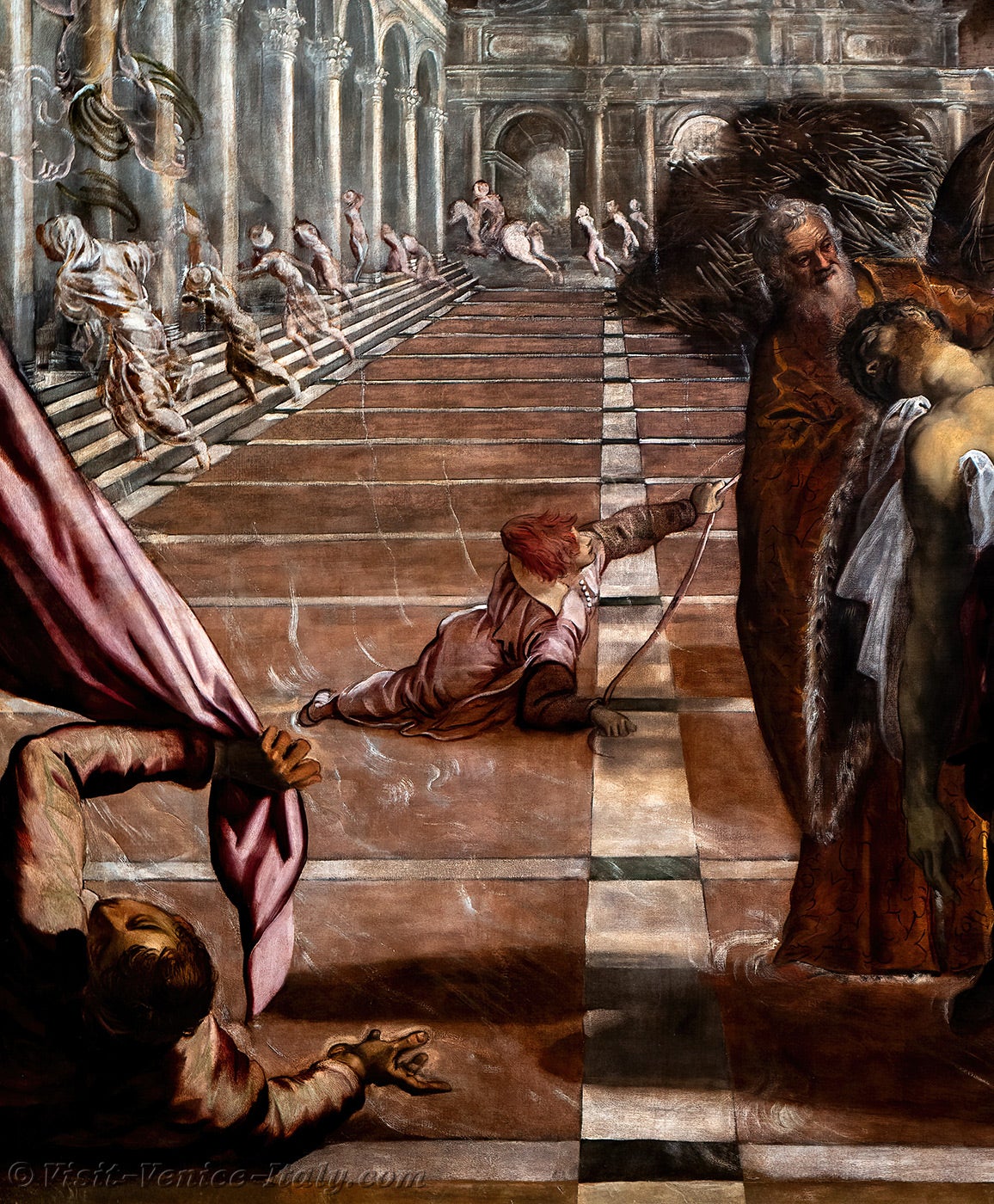
Translation of St Mark The pyre can be seen at the far end of the square, on which the Muslims had planned to burn the body of St. Mark.
Tintoretto transposed the scene—which normally takes place in Alexandria—to St. Mark’s Square in Venice.
The camel, frightened by the storm, tries to escape, whilst a man who has fallen to the ground because of the animal tries to hold it back by its lead rope.
Tintoretto depicts St. Mark as if he were still alive, without the rigour mortis, and without his body appearing livid, which emphasises the miraculous nature of the scene.
The Christians who are in the process of removing the body of St. Mark from the Muslims show a certain eagerness to leave the square as quickly as possible.
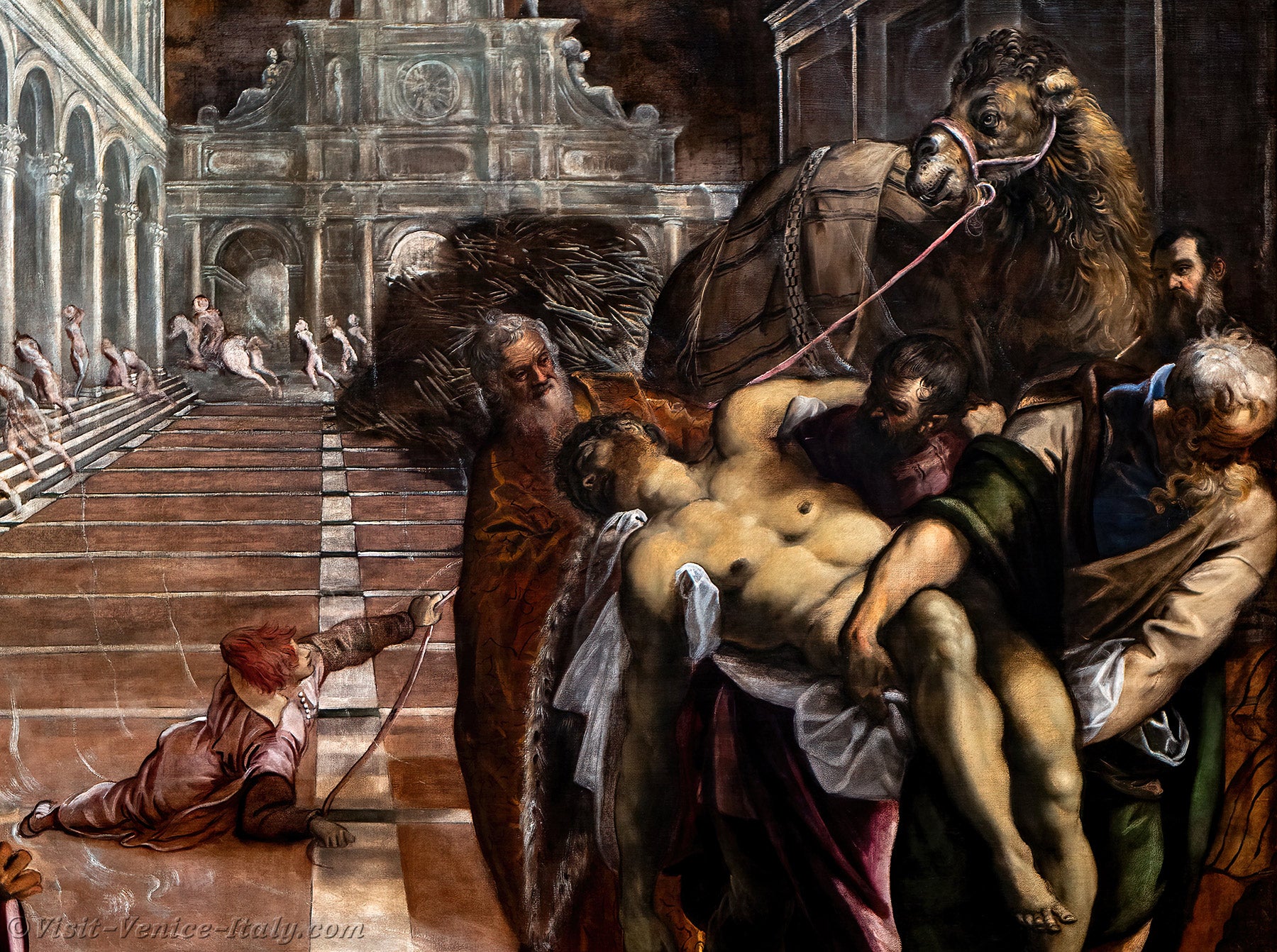
Translation of St Mark Tintoretto depicts the fleeing pagans by painting them in colourless tones, so that they blend into the colours of the buildings, as if they were evanescent, as if they were themselves spectres attempting to escape God’s wrath, whilst the only dead figure in the scene, St. Mark, is, by contrast, depicted in the colours of life.
This contrast, intended by Tintoretto, is all the more striking given that the rest of the scene is particularly dark due to the storm, whilst the saint’s body is colourful and luminous.
The perspective effects of the buildings framing the square, reinforced by the lines of the paving, help to highlight the saint’s body in the foreground of the painting.
Tintoretto Crucifixion | Cain Abel | Miracle St Mark | Jesus Temple | Translation St Mark | Lady Treasurers | St George Princess | St Mark Saracen | Adam Eve | Assumption Virgin | Deposition Christ | Creation Animals | Mocenigo | Soranzo | St Jerome Andrew
Artists Tintoretto | Veronese |
Accademia Artists | Location Schedule Tickets Authorizations
Back to Top of Page