

Archaeological Artworks | Location Schedule Tickets Authorizations
Artworks The Goddesses | The Dignitaries
Dignitaries Agrippina | Antonia | Faustina | Caracalla | Hadrian | Marcus Aurelius | Philip II | Tiberius | Trajan | Verus | Vitellius
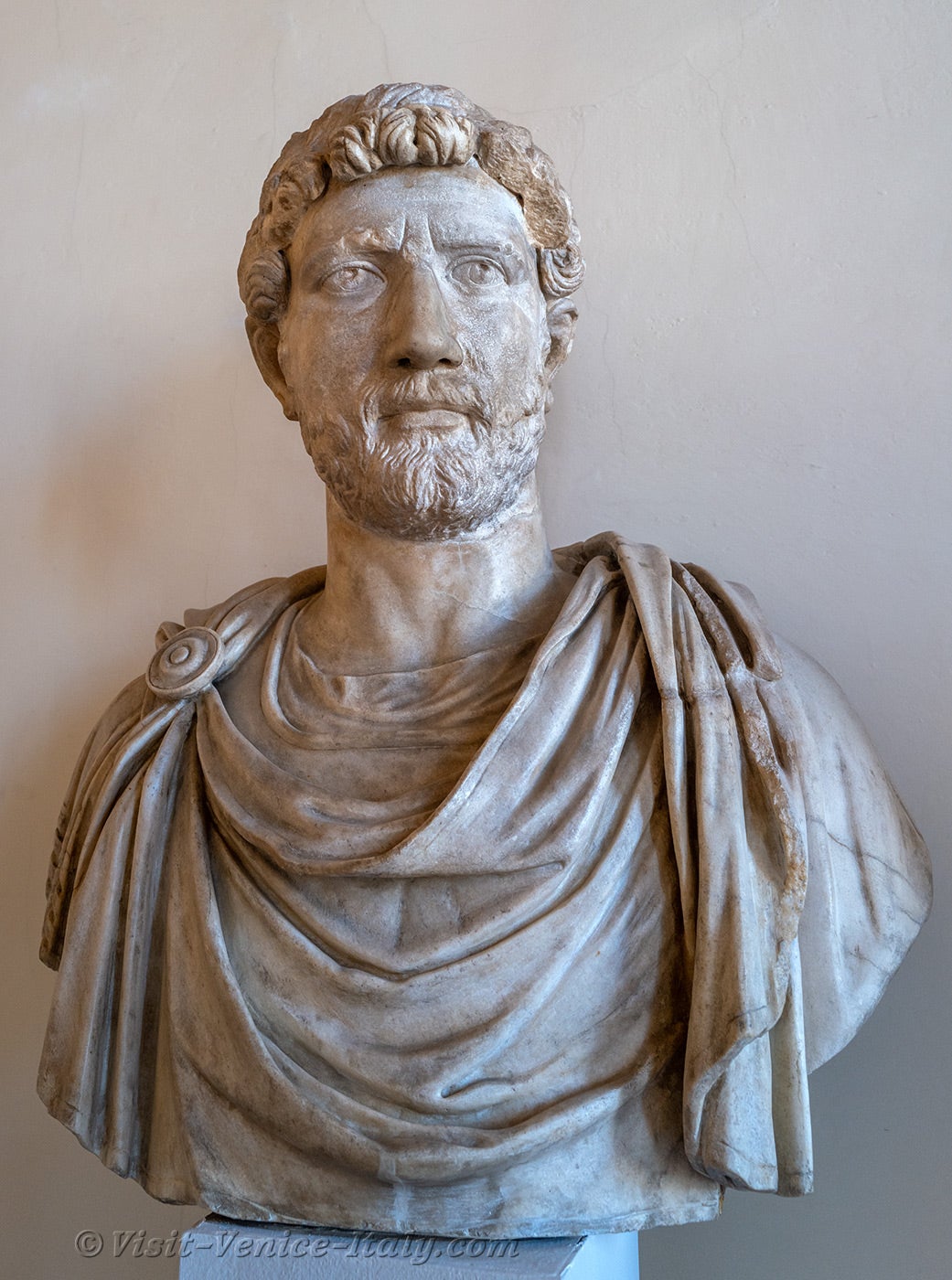
Emperor Hadrian at the Archaeological Museum of Venice
“Emperor Hadrian”
Sculpture – Marble (Height 86 cm) First half of the 2nd century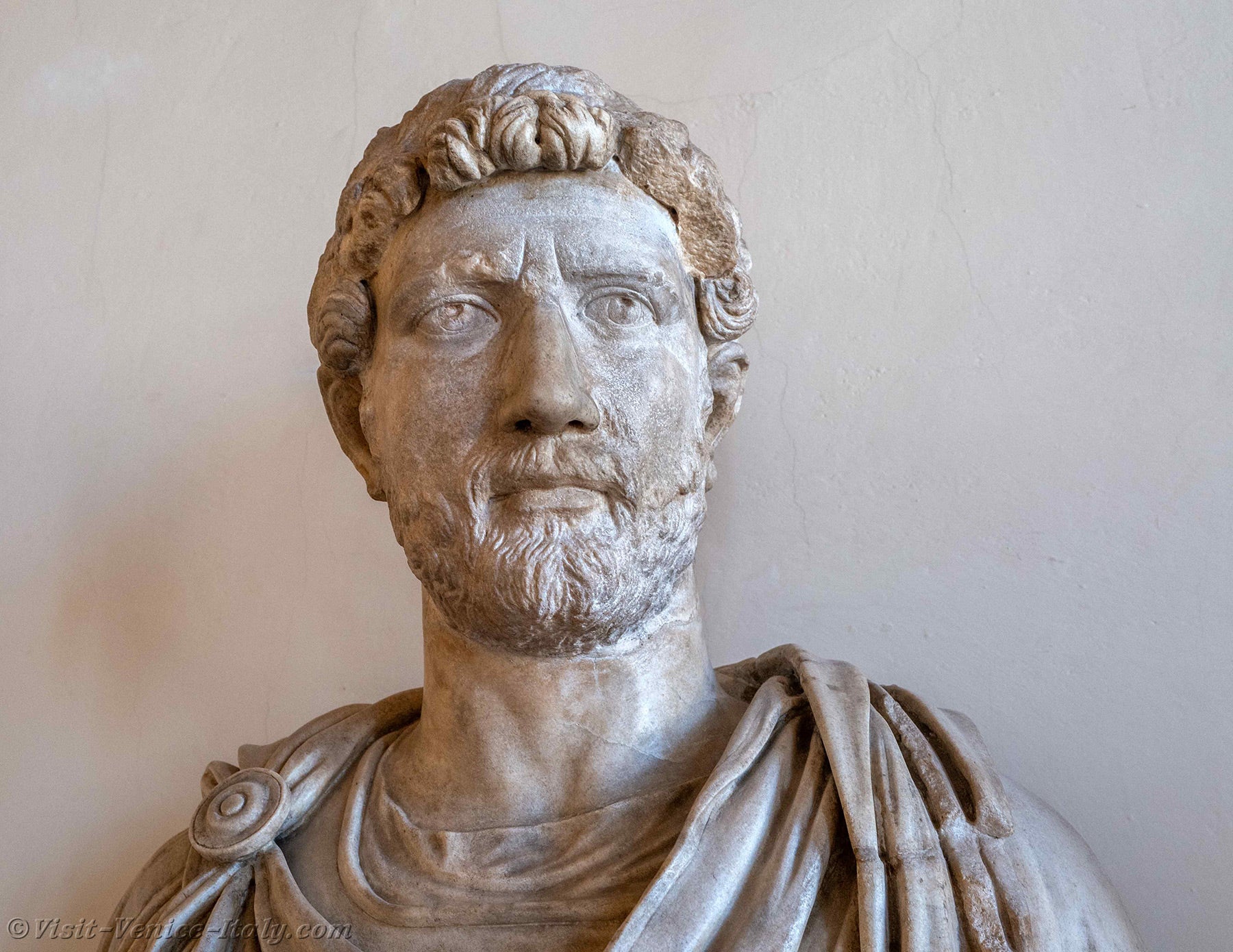
Emperor Hadrian This statue of Emperor Hadrian (76–138) shows him wearing the same type of tunic as that covering the bust of the young Caracalla, which is also on display at the Archaeological Museum of Venice.
This statue of Hadrian depicts him as a leader with a clear and determined gaze, but also as a thinker, for he was a man of letters, a philosopher and a poet.
He was fond of young men, in particular the famous Antinous.
Hadrian succeeded Trajan in the year 117, reigning until his death in the year 138, at the age of 62.
He commissioned the construction of the Pantheon, which remains intact to this day, as a temple symbolising paradise, intended to glorify his own imperial power.
Some historians believe that Emperor Hadrian designed the Pantheon himself and that he was behind this idea—which was astonishing at the time—of linking this circular temple, topped by a dome, with a Greek-style portico.
Emperor Hadrian His vision of the Empire was very different from that of Trajan, who had continually expanded it at the cost of successive wars.
Hadrian believed it was better to consolidate the Empire by securing the existing borders rather than continuing to expand it, with all the risks that entailed, not to mention the human and financial cost involved.
He was, in fact, aware of the weaknesses at the frontiers caused by Trajan’s rapid expansion of the Empire, and of the need to administer the new territories effectively to ensure the integration of their peoples.
To defend his borders, Hadrian had a 120-kilometre-long wall built in the north of England, complete with watchtowers and military camps: the famous Hadrian’s Wall, intended to protect the northern border of Roman Britannia, thereby separating England and Scotland.
He also established ‘limes’ all around the empire.
The ‘limes’ followed natural border features that were easier to defend, such as mountains and rivers.
Where there were no natural boundaries, he had walls built as in England, or palisades backed by ditches with watchtowers and military camps positioned along these natural or artificial defences.
Hadrian did not merely administer the Empire from Rome: he travelled throughout it and reorganised it over a period of more than ten years, offering the opportunity for the inhabitants of the annexed territories to gain Roman citizenship and encouraging the administration of the provinces by local elites.
This did not prevent him from acting as a political strategist in Rome, in order to secure the support of the people during those years of absence.
As such, one of his first decisions – an easy one when one is at the head of such a wealthy empire – was to cancel the Romans’ tax debts. Who could do better?
Dignitaries Agrippina | Antonia | Faustina | Caracalla | Hadrian | Marcus Aurelius | Philip II | Tiberius | Trajan | Verus | Vitellius
Artworks The Goddesses | The Dignitaries
Archaeological Artworks | Location Schedule Tickets Authorizations
Back to Top of Page