

Accademia Artists | Location Schedule Tickets Authorizations
Artists Tintoretto | Veronese |
Veronese Banquet Levi | Mystic Marriage | Battle Lepanto | Annunciation | Assumption | Coronation Virgin | Crucifixion | St Francis Stigmata
Veronese’s ‘The Banquet at Levi’s House’ at the Accademia Galleries in Venice
Paul Veronese (1528–1588) “The Banquet in the House of Levi”
Painting – Oil on canvas (555 x 1310 cm) 1573This very large canvas by Veronese was painted to be hung in the refectory of the Dominican convent of Santi Giovanni e Paolo in the Castello district of Venice, to replace the “Last Supper” painted by Titian, which had been destroyed in a fire at the convent.
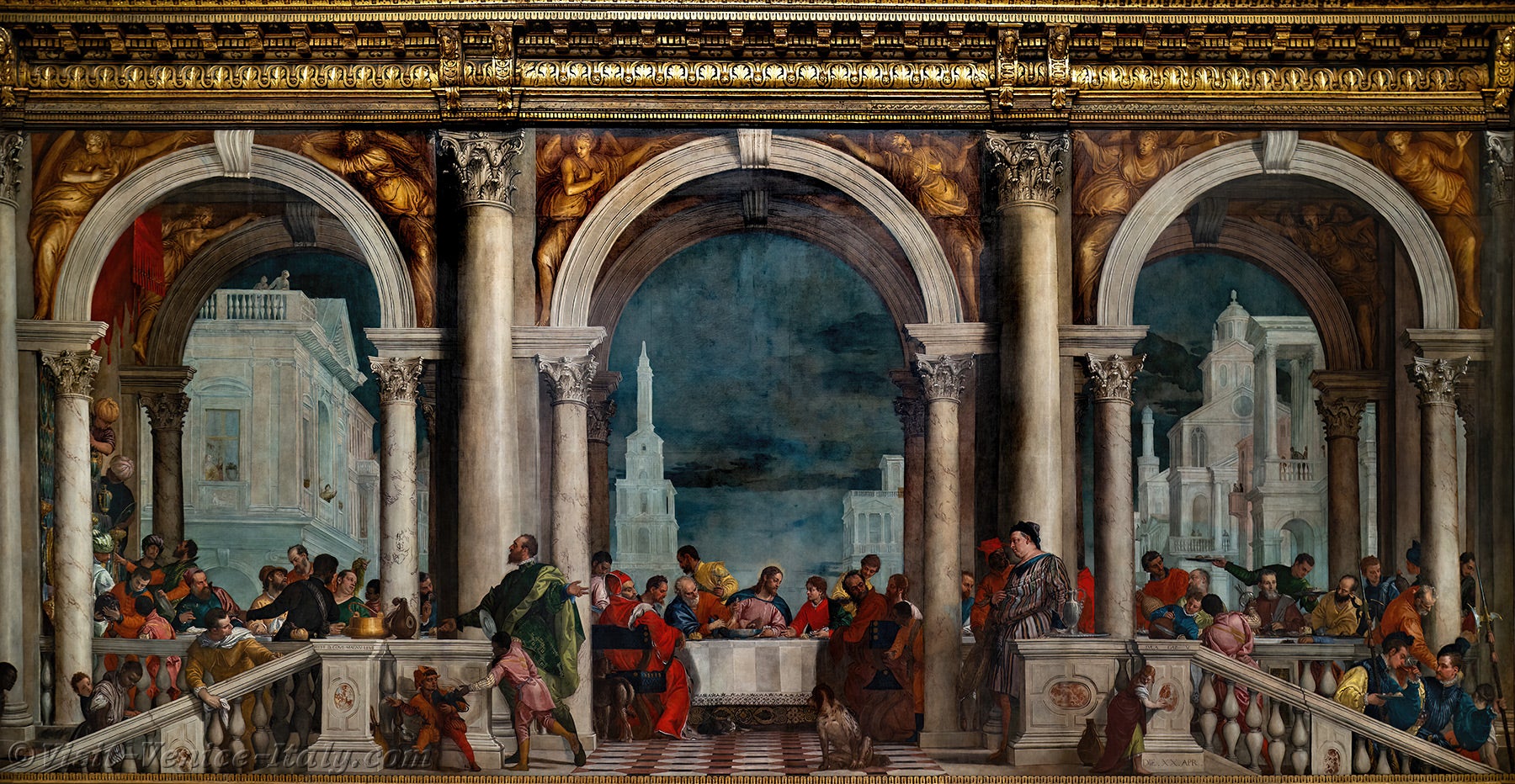
Banquet dans la maison de Levi The new Last Supper had been in place for barely three months when Veronese was summoned by the Inquisition, which suspected him of heresy for having painted his Last Supper whilst taking too many liberties with the canonical rules of the Eucharist then in force.
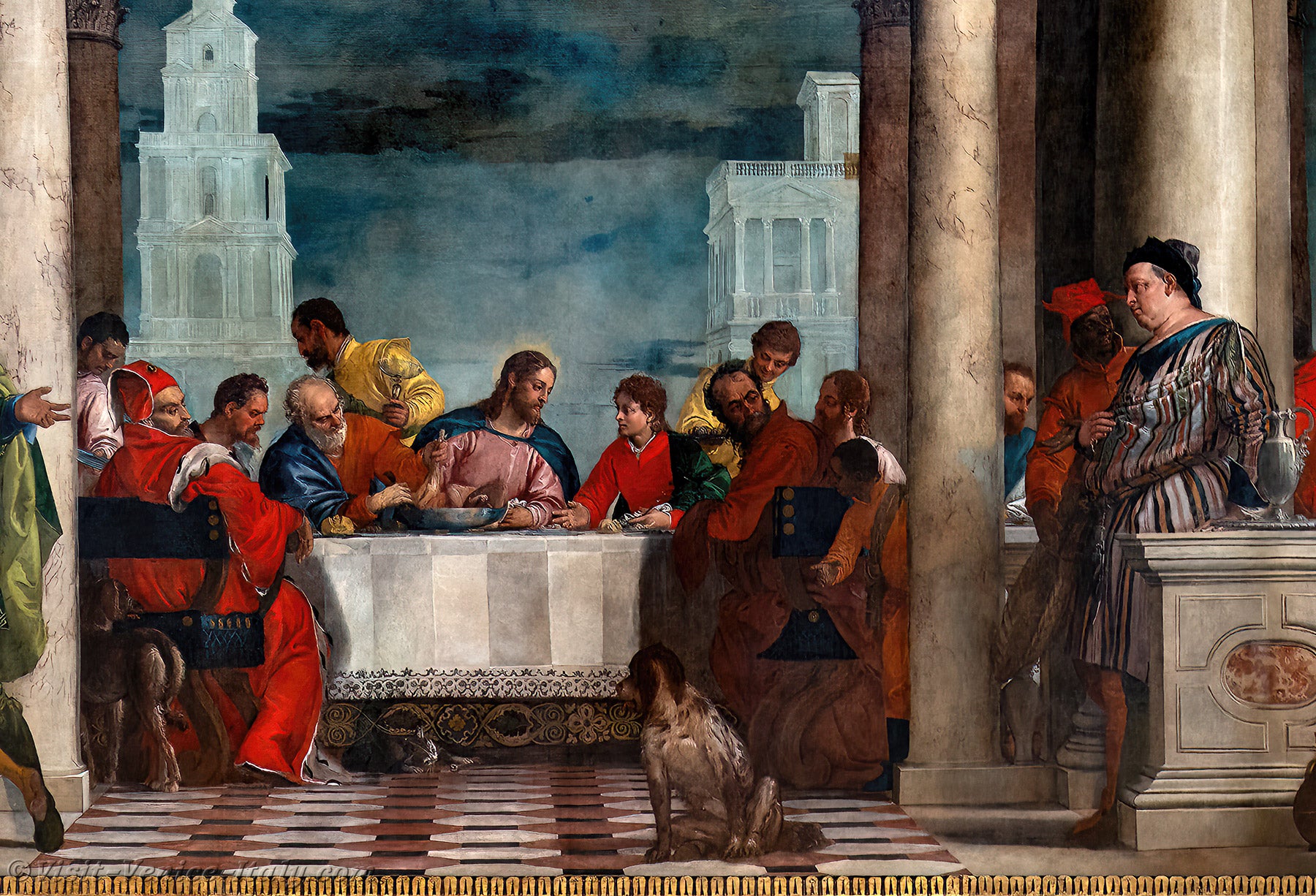
Among other things, he was asked to explain why Peter is shown preparing the lamb instead of Jesus, or why there is a jester with a parrot perched on his fist – a symbol of lust – as well as these soldiers carrying German weapons.
Veronese responded skilfully to these accusations by stating that a painter had the right to creative licence just like writers and poets, and that, following his imagination, he often painted according to the inspiration of the moment.
The court did not convict Veronese following his defence, but he was not off the hook just yet: he was granted a three-month deadline to alter, at his own expense, those elements of the work deemed contrary to the dignity required of the theme of the Last Supper of Christ.
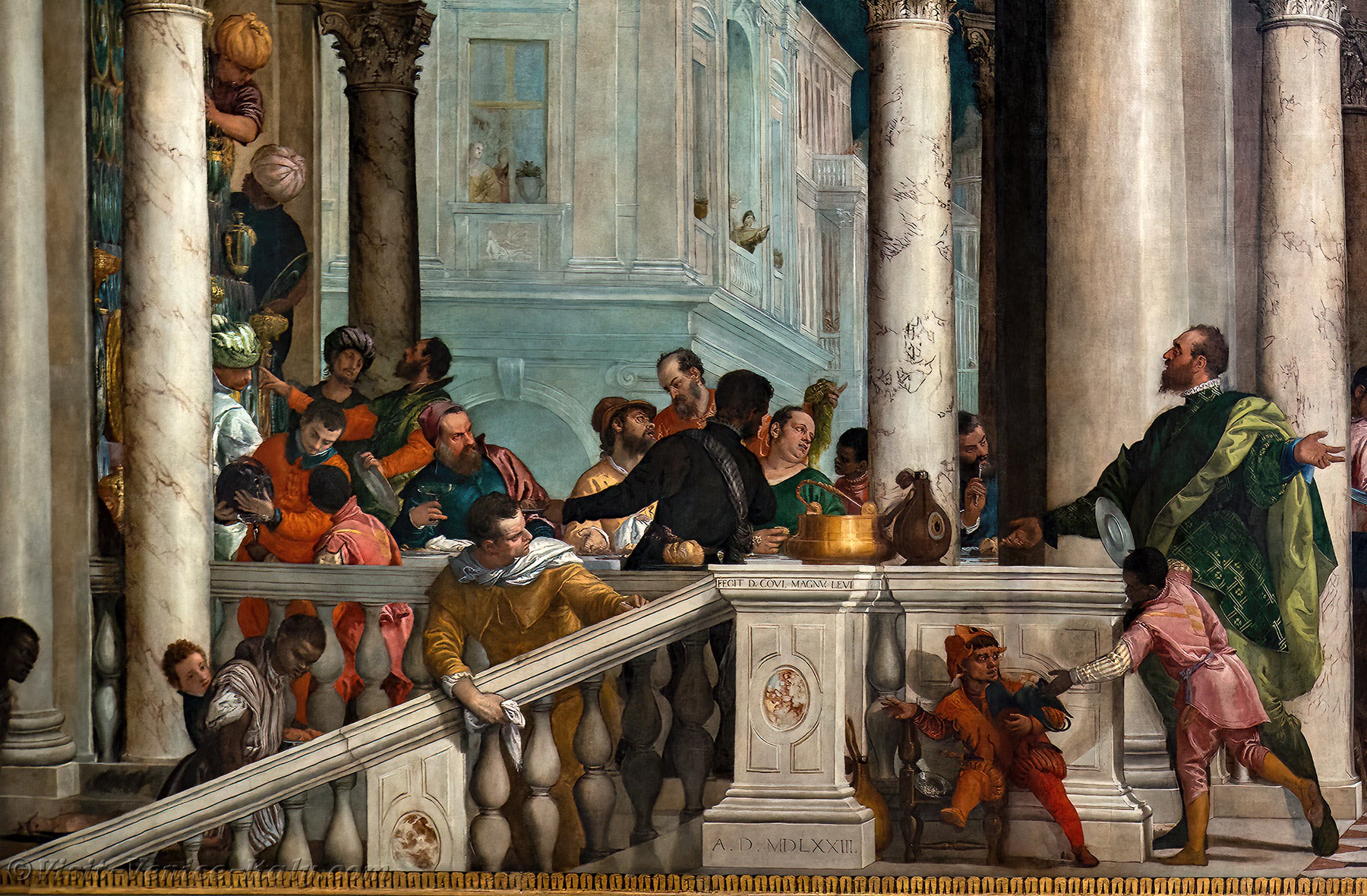
Banquet dans la maison de Levi But Veronese did not obey the order; instead of altering anything, he painted on the two pillars at the top of the staircase the following words: “FECIT D. COVI MAGNU. LEVI – LUCAE CAP.V”.
He had found a way to circumvent the Inquisition’s order by simply changing the title of his painting.
By removing the original title “The Last Supper”, which obliged him to ensure his painting conformed to religious doctrine, the astute Veronese transformed it into a secular work by renaming it: “The Banquet in the House of Levi”, ending the controversy!
It seems that Veronese’s approach was supported by a few friars from the Dominican friary, where at the time there was a certain spirit of rebellion amongst senior friars, who were suspected of apostasy, to the extent that some left the order.
Banquet dans la maison de Levi It is not known whether Brother Andrea de’ Buoni, the patron of the painting who had paid for it in full out of his own pocket, was part of this rebellion and might have suggested, either alone or with other Dominican friars, this ruse to spare Veronese from the wrath of the Inquisition; but it is quite possible.
In fact, this work depicts a Venetian banquet typical of Veronese’s time.
Indeed, it is noticeable that most of the guests are dressed as people were in the 16th century.
The wide variety of the characters’ costumes indicates their origins; these men come from all over the Mediterranean basin and from European countries to do business in Venice, the crossroads of trade that brought the city its wealth and power.
People are talking and chatting, whilst the servants rush about serving wine and food in abundance and the atmosphere is cheerful.
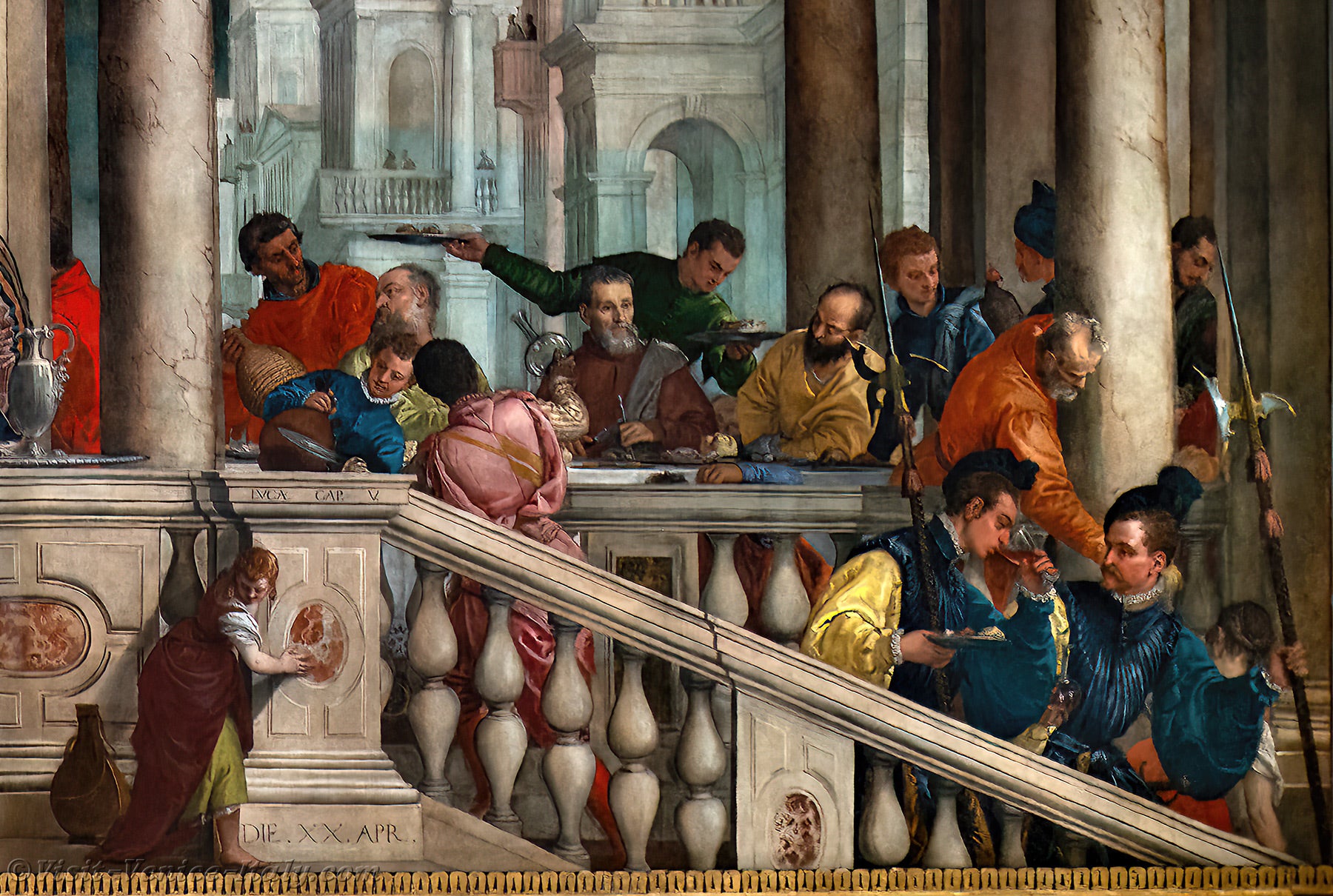
Banquet dans la maison de Levi Servants and soldiers are equally caught up in the festivities, whilst the only calm and solemn part is, of course, in the centre of the painting, with Christ surrounded by his apostles, serving as a reminder of the Eucharist’s message of peace and brotherhood.
This painting, created two years after the victory at Lepanto against the Turks, serves as a reminder that Venice is a free and Christian republic: the left-hand side of the painting, occupied by men in turbans, shows a certain degree of commotion in contrast to the right-hand side, where people are eating and drinking peacefully.
This work was an opportunity for the artist to fully exercise his talent by depicting the lives of the wealthy Venetians of the time, a display of prosperity enhanced by the vivid colours typical of Veronese’s works.
A perfectly balanced painting despite its enormous size and the impressive number of guests and servants – there are around fifty of them.
This balance is due not only to the architecture that frames and separates the different parts of the banquet, but also to the perfect interweaving of the figures in relation to one another, through their gestures, their positions, their gazes and their demeanours.
Veronese Banquet Levi | Mystic Marriage | Battle Lepanto | Annunciation | Assumption | Coronation Virgin | Crucifixion | St Francis Stigmata
Artists Tintoretto | Veronese |
Accademia Artists | Location Schedule Tickets Authorizations
Back to Top of Page