

History Important dates | Politics | Navy | Love | Wars | Religion | Scuole | Ghetto | Printing
Aldo Manuzio: The printing in Venice or the beginning of an industry
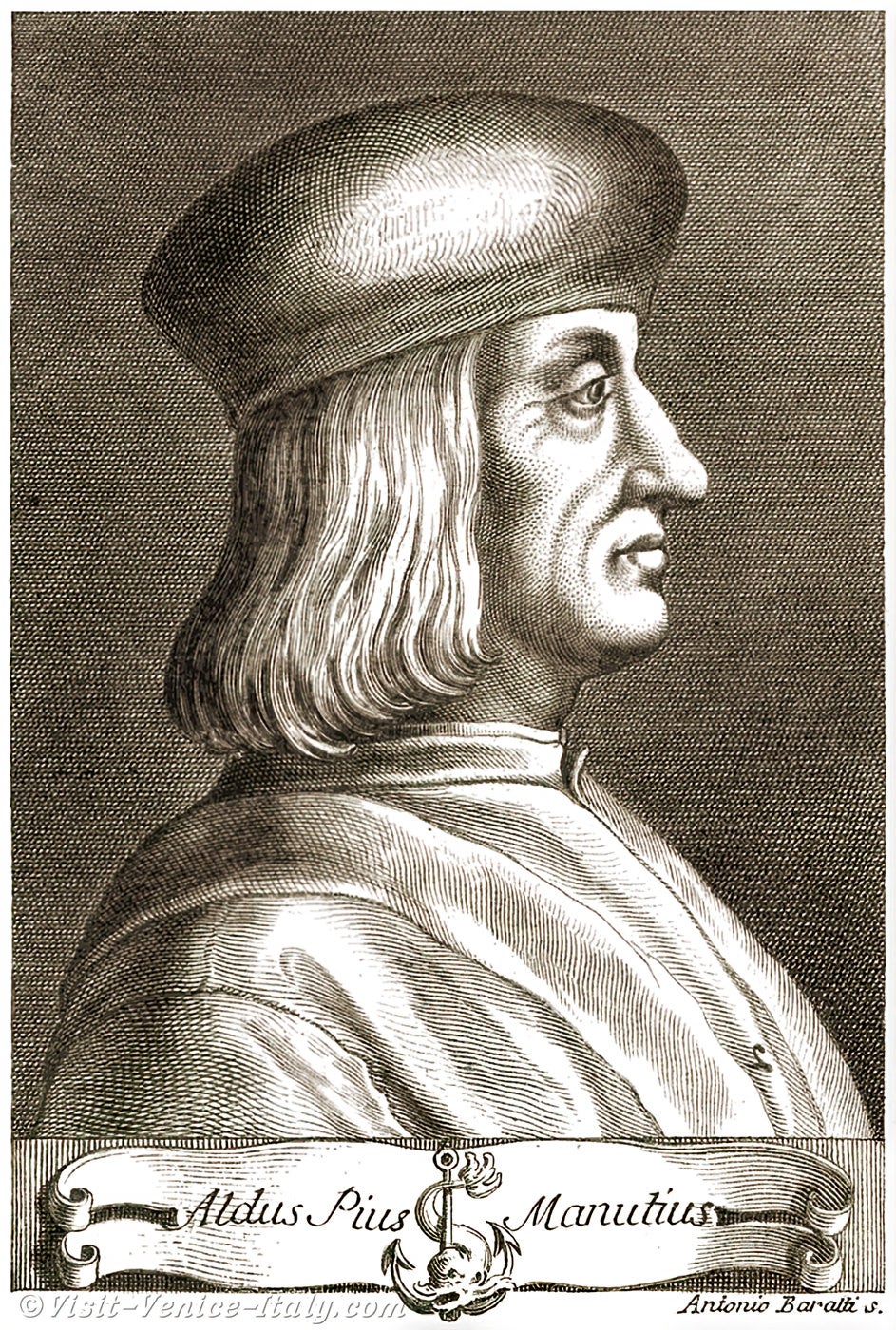
Aldo Manuzio The wars of Italy of the 16th century disturbed the activity of printing except in Venice, where their political neutrality allowed them to continue the development.
Venice, n°1 of edition in Italy
As a result: It was three times less pricy to edit in Venice than in Rome.To understand the importance of the printing in Venice from this period, it is enough to know that the 113 Venetian editors-printers printed 325 times more books than those of Florence, Milan and Rome united!
Between 1495-97, out of the 1821 titles that came from the presses of Europe, 447 came from Venice.
Paris, in 2nd position, published only 181!
Why print books in Venice?
Venice had numerous outlets - It had buyers throughout Europe.It commercialized the paper produced in Italy.
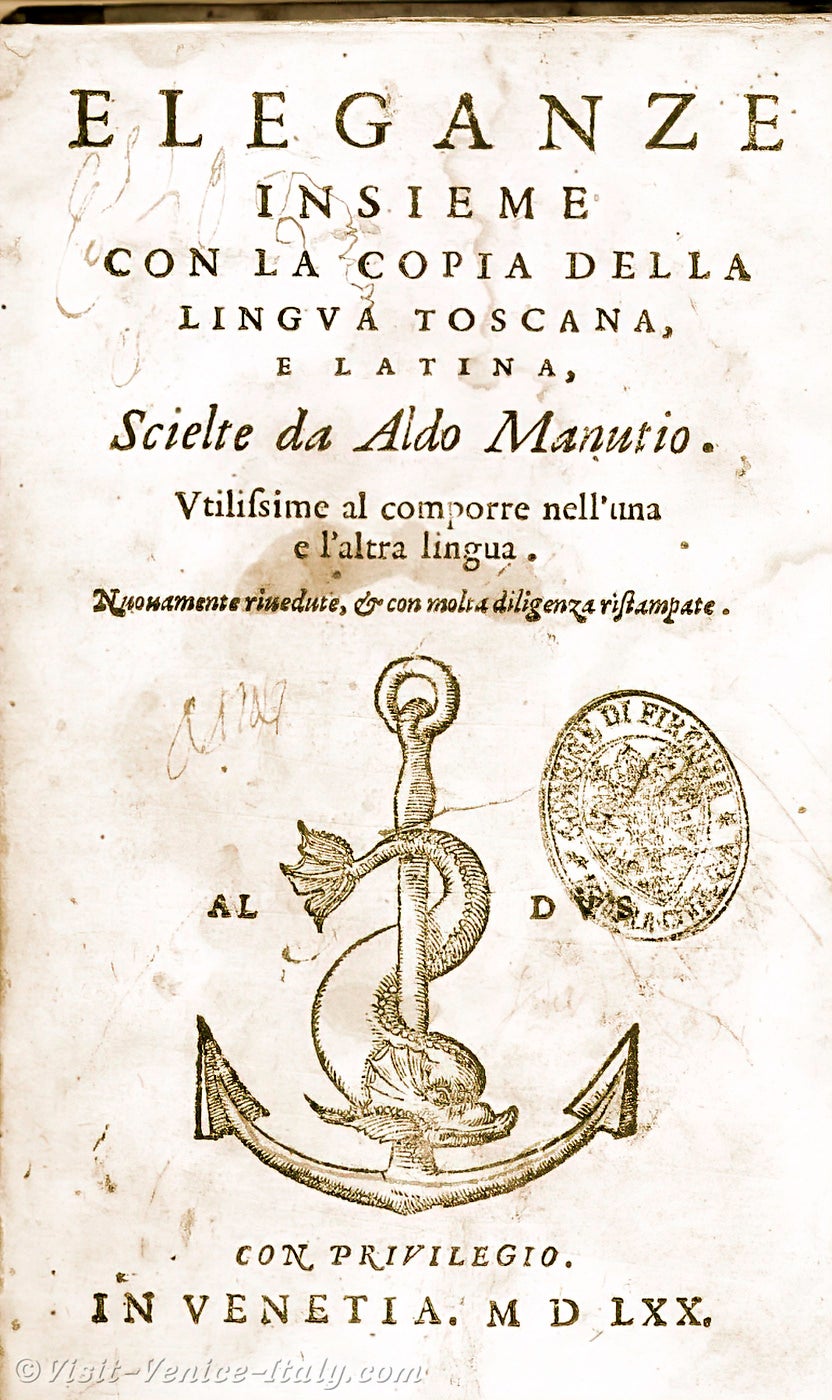
Aldo Manuzio Book They could provide skilled workers, and numerous people in their community were cultivated readers.
Many Jewish, Greek and Armenian scholars lived in Venice between 1492 and 1453 and the Venetian government granted easy licenses and reproduction rights.
At the beginning of the 16th century, the Venetian printers produce their most beautiful writings: there is competition with the producers of manuscripts and the illuminated codex.
The humanists appeared among the best customers.
1495: Aldo Manuzio founds the Aldine printing house
As a good humanist, Aldo Manuzio decides that :“Those who cultivate the humanities have to acquire books necessary for their purpose, and I could get no rest until the supply is assured.”
Aldo Manuzio
Assisted by the funds of Andrea Torresano, he buys quality punches manufactured by Jensen (a great specialist who became established in Venice) and called upon craftsmen able to carve the moulds of Greek characters whose drawing imitated the calligraphy of the old authors.
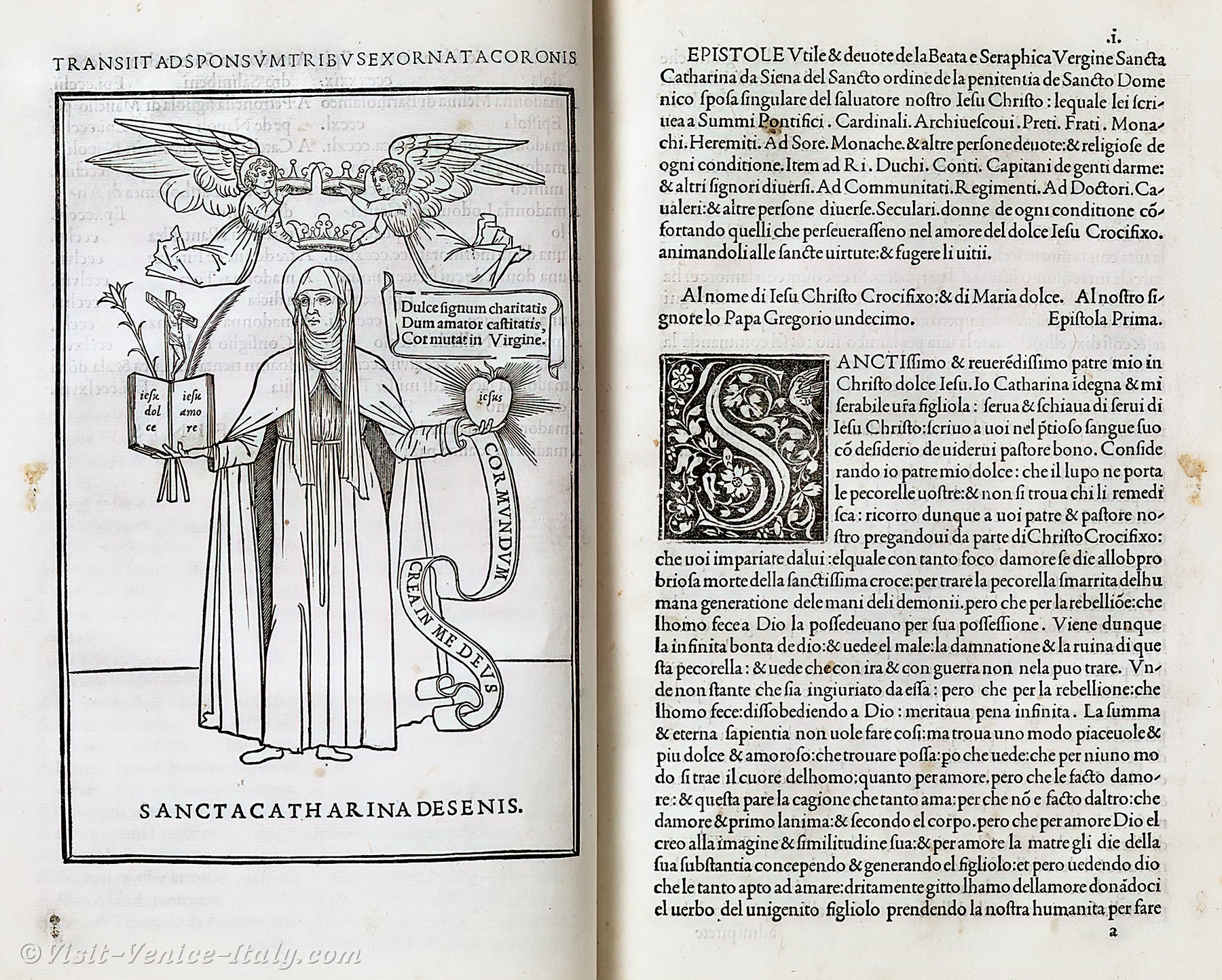
Hypnerotomachia Poliphili Let us note, among the famous employees of Aldo Manuzio, Erasmus from Rotterdam.
Aldo Manuzio and the Creation of the italics
Aldo Manuzio draws a block capital which gets closer to the handwritten writing.He calls it italics.
It takes less space on paper than the usual characters.
Aldo Manuzio and the creation of “the Octavo” and the Pocket Format!
The ancient books were quite large and very heavy.Aldo Manuzio has the idea to fold these big sheets of paper into 8, which creates 16 printed pages, and he names it “the octavo”.
Because the resulting book was 8 times as small!
Quality and effectiveness of industry of the book
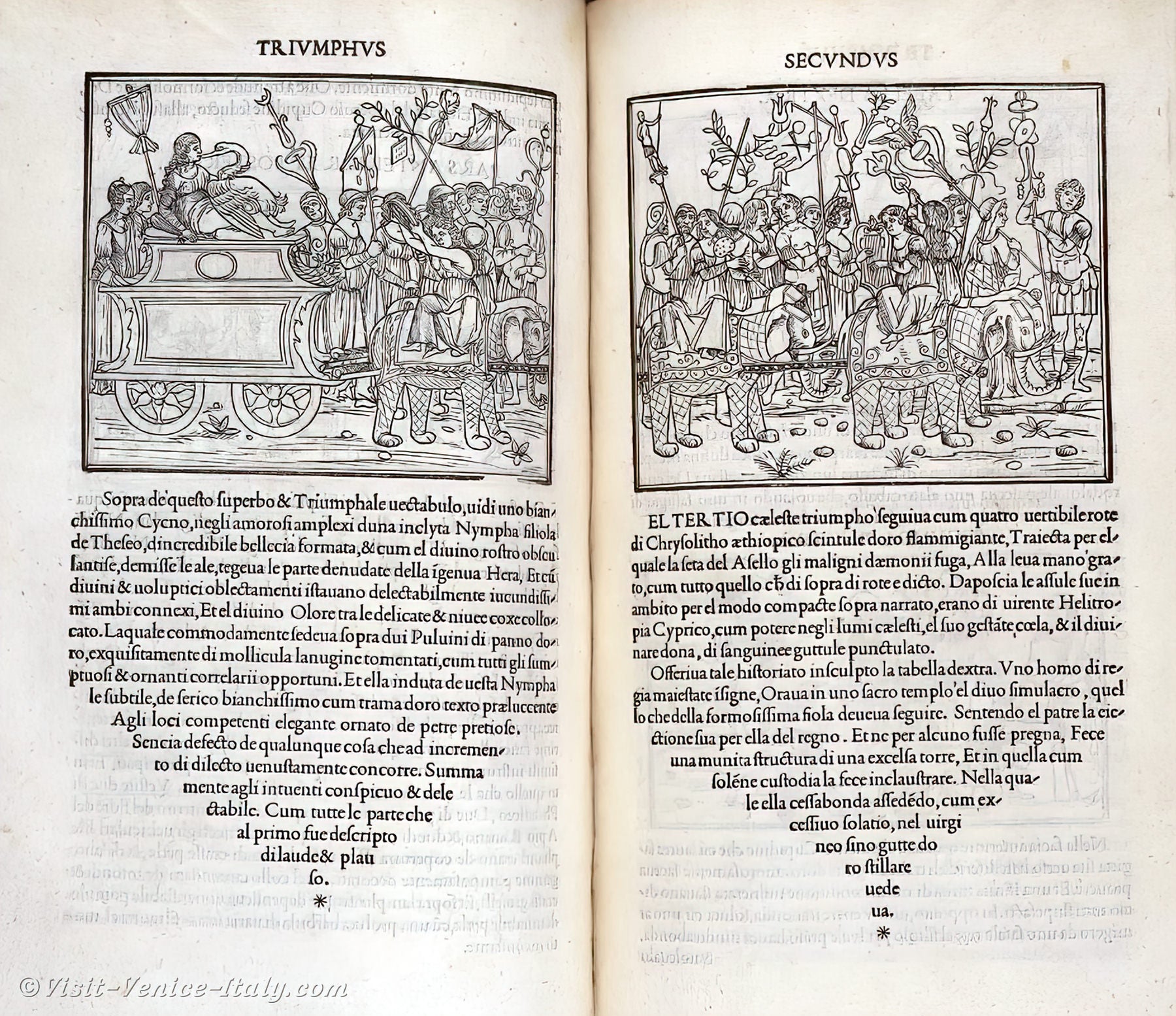
Hypnerotomachia Poliphili The Aldine printing used in full-time and in the single place more than 30 employees.
They were all highly skilled craftsmen, apprentices, tradesmen, operators, and especially scholarly people to proofread, as Erasmus for instance.
Aldo Manuzio had chosen as his emblem a dolphin and an anchor, symbols of speed and reliability. Aldus = Aldo, in Latin.
Aldo Manuzio succeeded in reducing the size, weight and expense of books by determining what will make them approachable to a vaster market.
What will allow the extension of the edition of the writings of entertainment?
Thus Venice attracted authors whose writings were well sold. The first author to leave the courtyard of a prince to live a free existence in Venice will be the famous Pietro Aretino.
Important dates | Politics | Navy | Love | Wars | Religion | Scuole | Ghetto | Printing
Back to Top of Page